Vodun Days Ouidah · 9 min
Vodun Days in Ouidah: dates, programme, advice
The 4th edition runs from 2 to 9 January 2027, followed by the main vodun ceremony on the 10th. Eight days, against three before. Here is what happens, how to prepare, and how to behave.
Vodun is not folklore
Let us start with what matters. Vodun is a living religion, practised every day by people who have jobs, children and mobile phones. It is not a backdrop, not a leftover, not a performance staged for visitors. In Ouidah the Python Temple receives worshippers in the morning and travellers in the afternoon, and the basilica stands on the other side of the same square. The same families move from one door to the other without seeing a contradiction.
That changes everything about how you attend the Vodun Days. You are not buying a seat at a festival: you are received into something that happens anyway, with or without you. So the rules are not those of a concert hall. They come from the people receiving you, they differ from one convent to the next, and they are not open to negotiation. It is the first thing Tony explains, before he even mentions the programme.
What the Vodun Days in Ouidah are
Every January, Benin celebrates its endogenous religions, and Ouidah is the heart of it. In 2027 that means 2 to 9 January, with the main vodun ceremony falling on the 10th. The town is low, sandy and normally quiet between its ochre walls and its mango trees. Within hours it changes scale. The streets fill, drums start in one quarter and are picked up in another, processions take the place of cars. You sleep little and walk a great deal.
We will not publish dates here. They are announced each year, and an article that pinned down a specific day would be wrong twelve months from now. If you are aiming for that window, write to us: we pass on the edition dates as soon as they are known, and we tell you plainly what is still possible. Flights, leave and accommodation are arranged after that announcement, never before.
What happens over those days
The processions and the drums
You hear it before you see it. One drum, then three, then a wall of sound that rattles the tin roofs and sits in your chest. The convents come out. The processions move forward, stop without warning, move on. Costumes of raffia and cloth spin until they become cones of colour. The crowd parts by instinct and closes again behind: you learn to do the same very quickly.
The one rule worth keeping in mind while things are moving fits in a sentence: follow, never get in front. Let them pass, keep your distance, and never cut through a procession, not even to cross the street.
The convents that receive
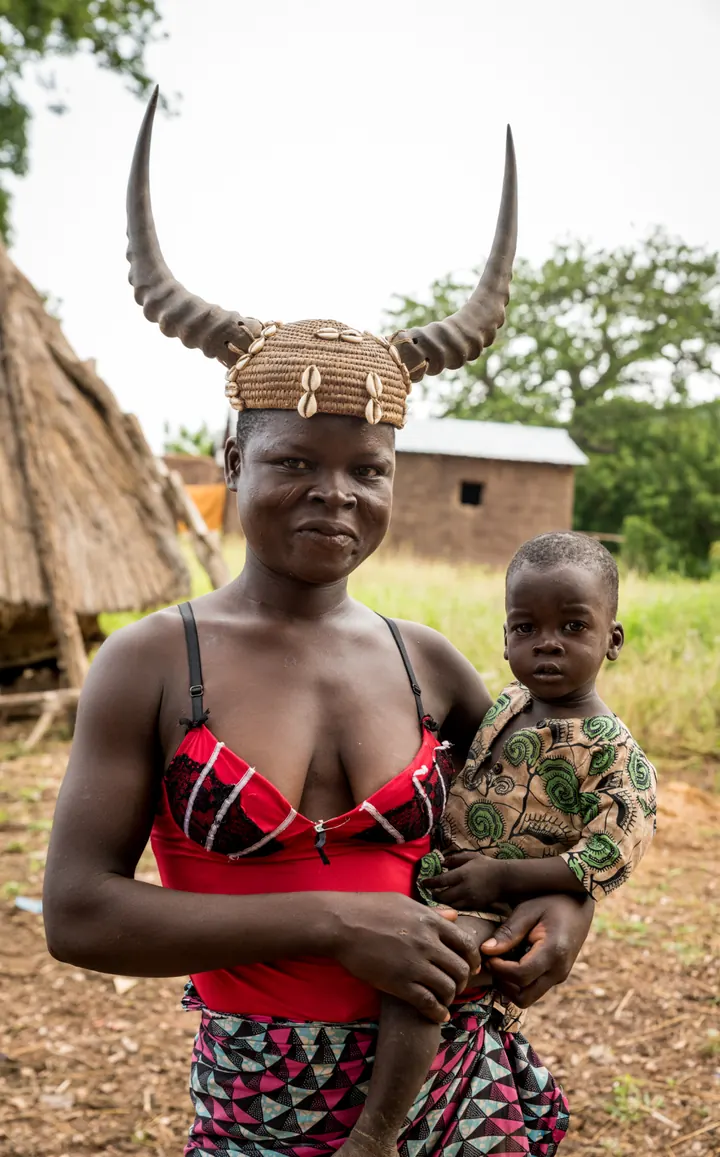
Courtyards open during these days, and what is shown inside depends entirely on the people who live there. You go in when you are invited, take off your shoes when asked, and sit where you are placed. Some things will be explained to you at length; about others you will be told nothing at all. Silence is an answer too, and it is to be respected.
The diaspora coming home
This is the time of year when you hear Portuguese, Creole and English in the streets of Ouidah. Part of the diaspora comes home — from Brazil, Haiti, the United States, Nigeria — and not as tourists. Some are looking for a name, a family, a line broken centuries ago. The conversations that begin on a bench in the shade are often worth the journey on their own.
Ouidah’s sites, in another state
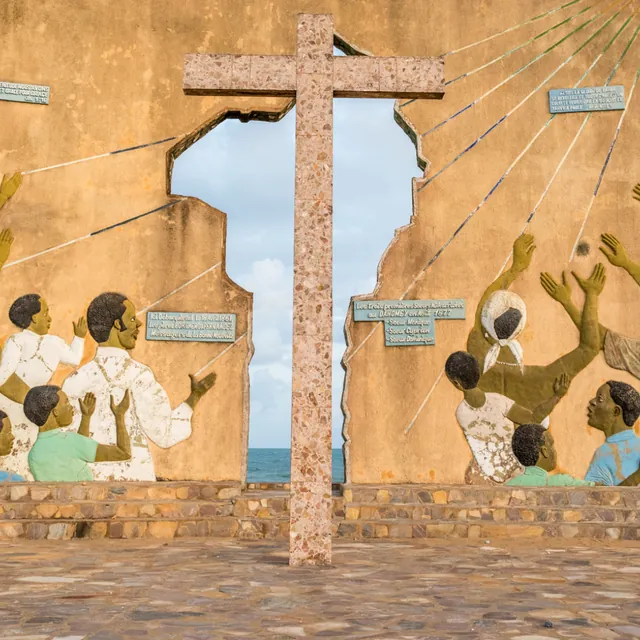
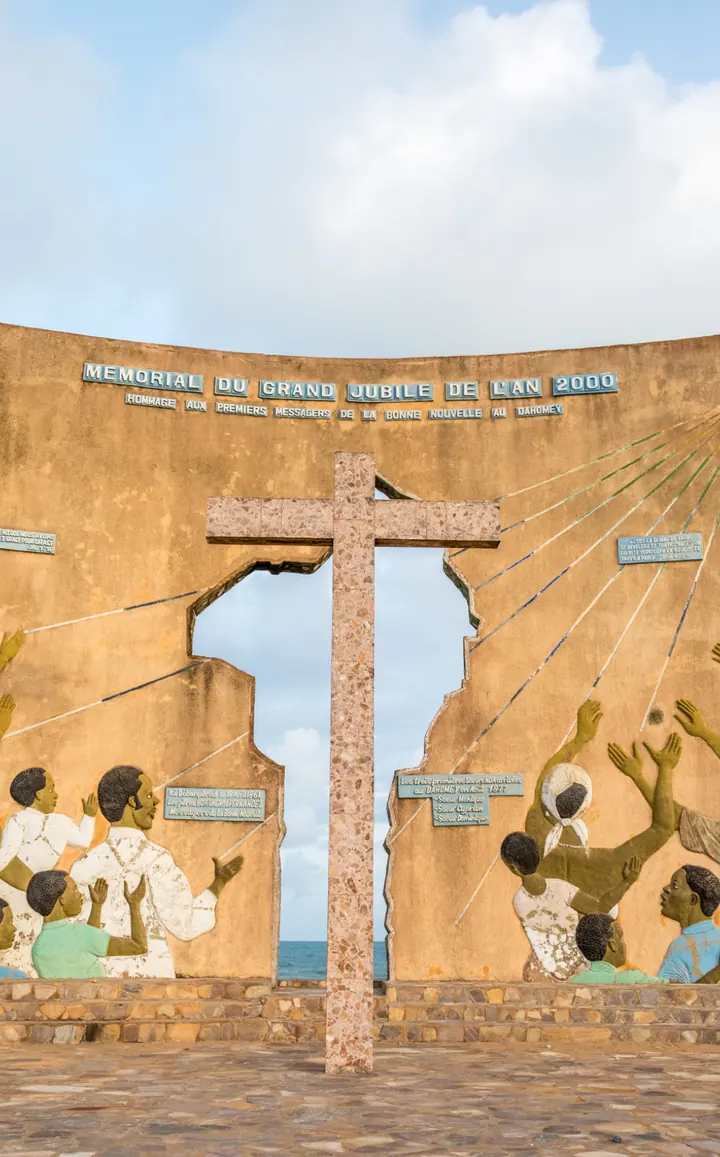
The Python Temple, the Slave Route and the Door of No Return are walked in an entirely different way during the event. The sand track running down to the ocean, usually silent between its memorials, carries crowds and noise. The Tree of Forgetting, the Zomaï hut, the Memorial of the Great Sacrifice: the same stones, a completely different context.
We suggest not cramming everything into those days. Keep half a day before or after, quietly, to walk back down the Slave Route without the crowd and to cross the sacred forest of Kpassè at the hour when the noise of the motorbikes stops at the gate. They are two different experiences, and one does not replace the other.
Preparing: it is all decided months ahead
The bottleneck is neither the flight nor the visa: it is the room. Ouidah is not a hotel town, its capacity does not move, and in January the number of visitors goes up all at once. Past a certain point it is not a question of paying more: there is nothing left. That is the only reason we ask you to book several months ahead — not to rush you.
- Dates first. Wait for the edition to be announced, then book leave and flights — in that order, never the other way round.
- Accommodation next, and as early as possible: it is the first thing to run out, in Ouidah and around it.
- Formalities in parallel: valid passport, e-visa, international vaccination certificate. Requirements change — check them on the official portals.
- Cash in CFA francs. Markets, transport, contributions asked for on the spot: cards work almost nowhere.
- Closed shoes, a hat, a water bottle. It is hot, there is sand everywhere, and the days are long.
- Something decent for ceremonies: shoulders and knees covered, shoes that come off easily.
How to behave: respect and photographs
You ask before photographing, always, and you accept a refusal without pushing. The rule is not the same from one convent to the next, nor from one day to the next: what was allowed yesterday may not be allowed this morning. A photography fee or a contribution can be asked for on the spot. That is normal, and it is settled before the picture, never after.
- Do not climb on memorial stones or low walls to get a better angle.
- Do not touch the costumes, the ritual objects, or anyone in trance.
- Do not cut through a procession, and do not stand in its path to frame a shot.
- Lower your voice near a group at prayer, and turn off the music in your earphones.
- Do not publish a recognisable face without having asked that person directly.
One thing travellers are rarely told: these days are physical. The noise, the crowd, the heat and the sheer length of them add up, and some scenes are overwhelming. There is no shame in stepping out of the procession, sitting in the shade for a while and coming back afterwards. Nobody around you will notice, and Tony will have seen it coming before you did.
Attending with us
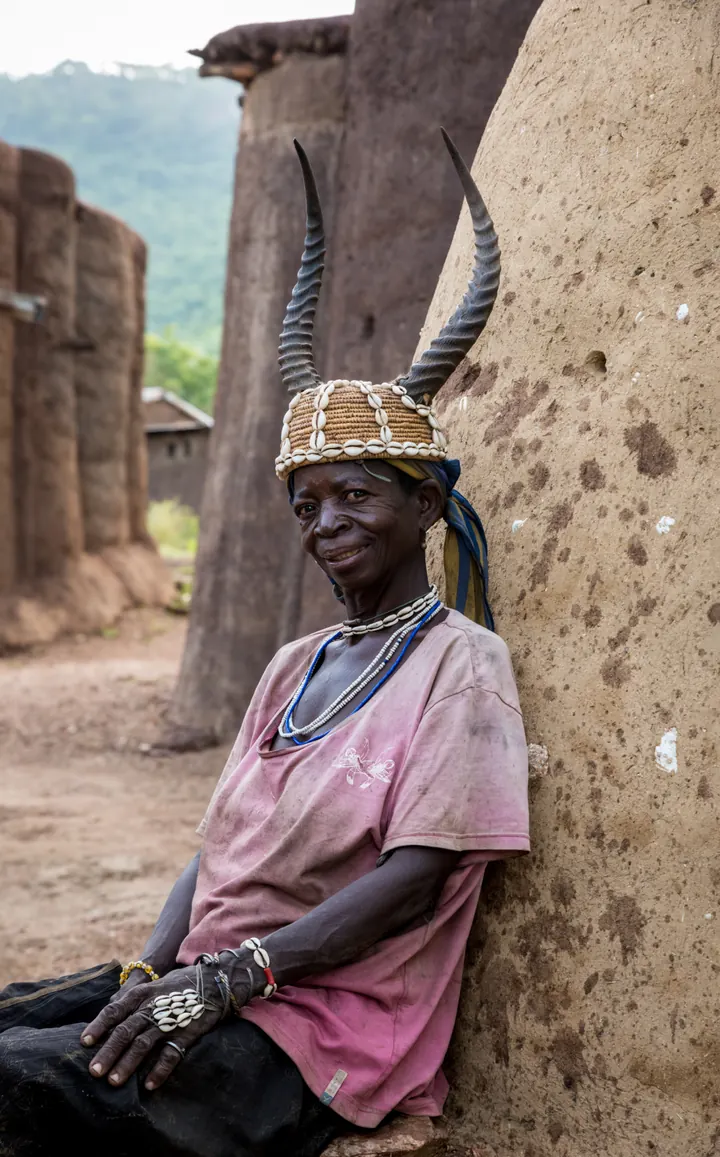
We attend the Vodun Days with Tony, who is from here and knows the families of the town. It changes nothing about what happens in the street: it changes what you are told about it, who you are introduced to, and the moment someone advises you to put the camera away. The rules are given to you beforehand, not in the middle of a procession.
If your dates fall in January, we fold the itinerary around the event: you are in Ouidah at the right moment, and Cotonou, Ganvié and Abomey stay on the programme, simply redistributed across the fourteen days. Just tell us you are aiming for that window. The dates are out: 2 to 9 January 2027. We will reply with what is still available.
Frequently asked questions
They are announced each year, and we do not fix them in this article so as not to leave you with outdated information. Write to us saying you are aiming for that window: we pass on the edition dates as soon as they are known, before you book any time off.
A great deal of it is public: the processions take over the street and everyone sees them. The rest depends on the individual convents, and some things are not shown to any outsider. You go in where you are invited, you never push, and you accept that part of the event is simply not meant for you.
It depends on the child and their age. The days are long, the crowd is dense, the drums are loud and the heat is heavy. Plenty of Beninese families come with their children; if you are travelling with yours, tell us and we will plan a different pace, with breaks back at the accommodation in the middle of the day.
Mainly the scale. Vodun is practised all year round, in convents, families and temples, often without an audience. In January the celebration becomes collective and visible, the whole town is involved and the diaspora comes home. It is the same faith at a different intensity — and with far more people around.
We tell you as soon as we know, and we shift whatever can be shifted: the stages of the journey redistribute fairly easily. What moves less is flights and accommodation — one more reason to wait for the official announcement before booking anything irreversible.
Next step
Ready to actually go?
Tony builds the itinerary around whatever made you want to go. Just tell him what stayed with you from this article.
Answer within 24h · No commitment