Ganvié Benin visit · 7 min
Ganvié, the Venice of Africa: visiting, and doing it well
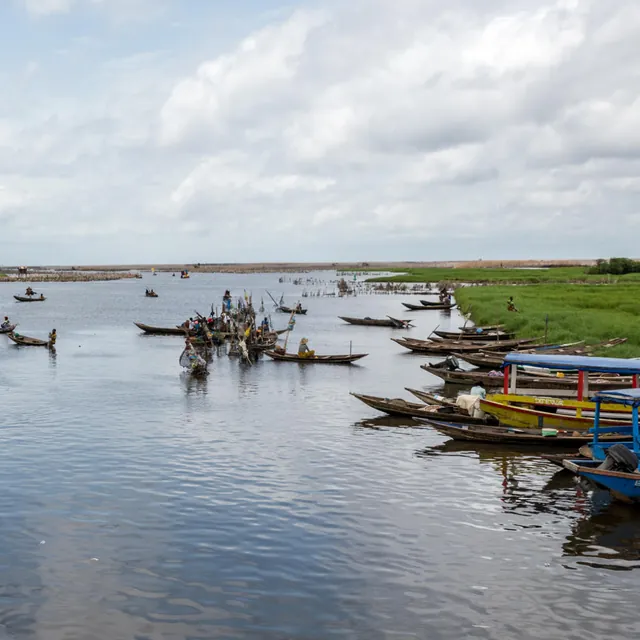
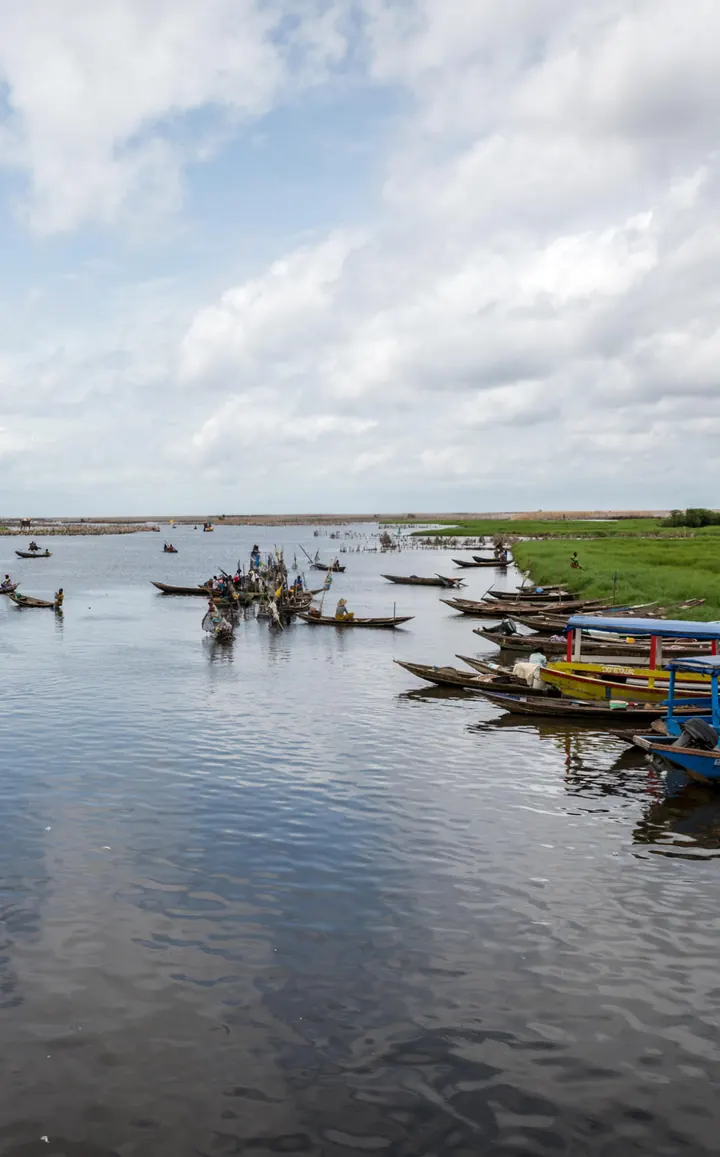
Ganvié stands on poles driven into the bed of Lake Nokoué: houses, shops, school and market all sit at water level. Here is what you see there, what you come to understand, and how to go without turning a lived-in village into scenery.
A town on the water, not beside it
There are no streets in Ganvié. There is no ground at all. You leave the house and step into a pirogue the way elsewhere you would take the stairs. The houses stand on wooden piles sunk into the mud, raised high enough for the lake to swell underneath them. Roofs are tin or thatch, laundry dries between two posts, and the background noise is not an engine but a pole scraping along the side of a hull.
Lake Nokoué opens out north of Cotonou. It is brackish water, connected to the lagoon and to the ocean, wide and shallow, where the morning light stays milky for a long while before the sky hardens. That is where the town floats — except the word is wrong. It does not float. It stands in the water, which is a very different thing.
The founding story, as it is told there
Someone will tell it to you during the crossing, and you need to hear it out there, on the water, for it to land. The Tofinu were fleeing slave hunters. They found the lake, and they understood that the hunters would not follow them into it. They stayed. They drove in piles, laid floors, raised walls. A town was born out of a hiding place, and it never moved again.
We pass this account on as it was given to us, in Ganvié, by the people who carry it. This is not a history paper and we are not claiming to say what an archive would say. What is certain is that the story is alive. It shapes the way people here talk about their town, and it explains why the water is not scenery but shelter.
What that changes for the visit
Everything, really. You are not visiting an architectural curiosity: you are crossing the result of an escape that worked. The nickname "Venice of Africa" is handy for placing the town on a mental map, but it points the wrong way. Venice grew out of trade; Ganvié grew out of fear. We use the phrase because everyone uses it, and we set it aside the moment we step into the pirogue.
Acadjas: farming fish without a net
Across a good part of the lake, the water is studded with branches planted upright. These are the acadjas. The principle fits in one sentence: you drive branches and bamboo stems into the mud over a marked-out plot, and let time do the work. Algae take hold on the wood, fish come to feed and to shelter, and the pen slowly turns into a larder.
At harvest time the plot is ringed with a net, the branches are pulled out one by one, and the net is drawn tight. From the pirogue, these pens cut the lake surface into geometric figures that run to the horizon. Each one belongs to someone. The boundary reads in the water the way a fence reads in a field, and nobody gets it wrong.
Once you know where to look, this is what you notice on the crossing:
- Rows of bamboo driven upright: every acadja has an owner
- Poled pirogues, far more common than motorised ones
- Children coming home from school standing in the pirogue, never once looking for their balance
- Houses raised higher than their neighbours: the lake does not sit at one level all year
- The bamboo platforms at every door, serving as doorstep, terrace and quay
The floating market, at first light
It is held hull against hull, and it starts early. The women arrive by pirogue loaded with smoked fish, tomatoes, chilli, cans of paraffin, soap. They come alongside, hold on to each other with one hand, trade, push off with a foot and go. Nobody steps out, because there is nowhere to step out to. Prices are called from hull to hull, and notes pass over the water.
It is fast, it is loud, and it is not a show: it is how a town with no lorries gets its supplies. Arrive mid-morning and there will not be much left to see. It is the only real timing constraint of the day, and it is why we board while the lake is still grey.
Boarding, and what the day looks like
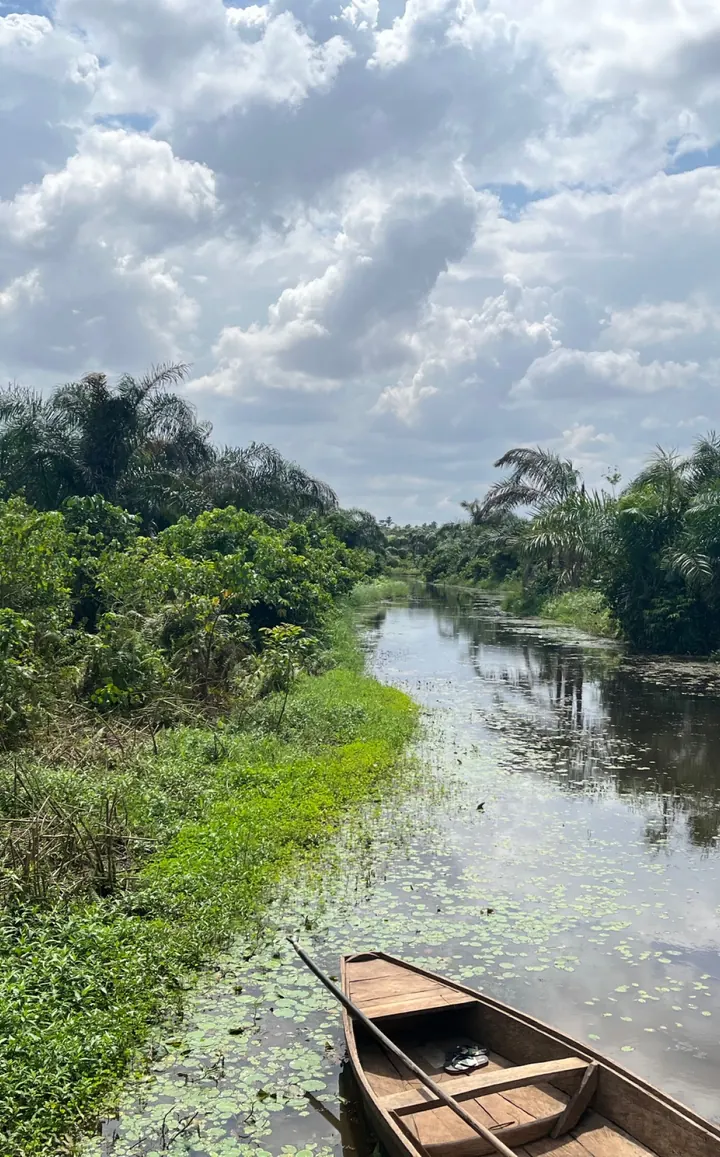
You board from the shore at Abomey-Calavi, north of Cotonou. The pirogue is wooden, long, low in the water. You sit on a plank laid across it, keep your bag on your knees, and go. The crossing is not a formality: it is already the visit. The lake opens, the acadjas file past, and the town arrives in pieces — roofs first, then piles, then whole façades.
After that the day follows the rhythm of the water. The market at first light, a fishing workshop, a Tofinu family receiving you at home, an unhurried lunch. Early in the afternoon the wind often gets up on the lake and the way back turns less comfortable: that is usually the moment to leave. Allow a full day. Ganvié is crossed quickly and understood slowly.
Visiting a lived-in village without making it a backdrop
This is the honest question about this visit, and it deserves to be asked out loud. Ganvié lives partly on tourism, and nobody there pretends otherwise. So the problem is not coming: it is coming badly. A pirogue that crosses the town at full throttle in a few minutes, lenses trained on the windows, leaves money with a boatman and nothing else behind it.
We do the opposite, as far as we can. We slow down, we stop, we go inside somewhere, we buy locally, we stay long enough for someone to have time to ask us a question back. It does not settle everything — a traveller is still a traveller, and a visit is still a visit — but it moves the needle the right way.
A few simple rules that change a great deal:
- Ask before photographing a person, an interior, a child
- Buy and eat locally rather than bringing your own picnic
- Hand nothing directly to children: go through the adults who are hosting you
- Throw nothing into the lake, not even a fruit peel
- Keep your voice down: on water, everything carries from house to house

When to go, and at what hour
From November to March the dry season gives the best conditions: a calmer lake, good roads on the way in, and superb early light. The rest of the year the visit is still possible; rain and wind decide how comfortable it is, not the town, which never closes.
Either way, the hour matters more than the season. The market is an early-morning affair, and the way back is gentler before the wind gets up. A Ganvié visit that starts late in the morning misses both, and shrinks to a round trip in a boat.
Ganvié within the journey
For us, Ganvié is not a standalone excursion. It sits inside the lake stage of the fourteen-day Benin journey, just after the Route des Pêches and before heading up to Abomey. We give it a whole day, unhurried, because that is the minimum for the town to stop being a picture and go back to being a place where people live.
If you would rather build your trip differently, just tell us what you want to see. We shape the itinerary around your dates and your interests, and Tony stays reachable before, during and after the trip.
Frequently asked questions
We give it a full day, from first light to early afternoon. A half-day is possible and plenty of operators sell it: you see the town, you meet nobody. The difference is in the stops — a fishing workshop, a house where you sit down, a lunch that takes its time.
No. The pirogues are wide, low and stable, and Lake Nokoué is shallow. If you are uneasy on water, say so before boarding rather than halfway across: we adjust where you sit and how fast we go.
A pen of branches and bamboo driven into the lake mud. The wood grows algae, fish come to feed and shelter there, and the plot is later harvested with a net. It is a form of husbandry rather than fishing in the usual sense — and every pen has an owner.
You can find a boatman at the landing and make the crossing. What that gives you is a loop on the lake. What actually changes the day is being introduced: going into a family’s home, asking questions and getting answers assumes someone is vouching for you. That is what Tony does.
Yes, and children are often the ones most at ease there. Bring a hat, sunscreen and water: there is no shade in a pirogue and the day is long. Tell us their ages when you enquire and we set the length of the day around them rather than the other way round.
Next step
Ready to actually go?
Tony builds the itinerary around whatever made you want to go. Just tell him what stayed with you from this article.
Answer within 24h · No commitment