A low, sandy town, made for walking
Ouidah sits on the coast, west of Cotonou. The town is low and spread out: wide streets, sand creeping onto the pavements, ochre walls, mango trees casting shade in the middle of the road. The centre is walkable. For everything else you take a zémidjan, one of the motorbike taxis waiting at the corner of every square.
What to do in Ouidah comes down to a sequence rather than a monument: a temple you enter barefoot, a sand track running down to the ocean, a wood that has never been cut. The three fit into a single day if you rush. We suggest not rushing.
The Python Temple
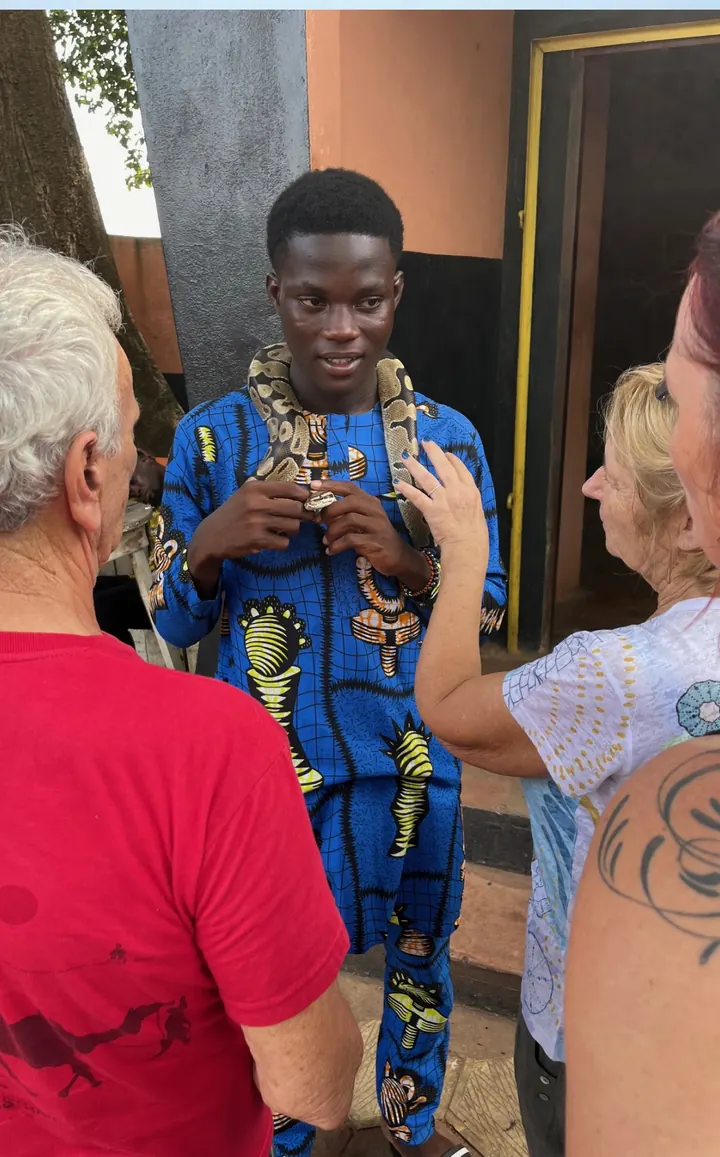
The temple stands in the centre, on the main square. You come in through a courtyard, take off your shoes, and a keeper of the shrine explains before showing you anything. The royal pythons live there. They are slow, warm, heavier than you expect; the one settled on your shoulders does not grip, it is only looking for support.
It is worth saying what it is not: neither a vivarium nor a performance. The python is the animal of Dangbé, the deity of the place, and the temple receives worshippers as well as visitors. You follow what the keeper says, including when he says no; you do not open doors that are not opened for you; you ask before photographing.
The basilica, right across the square
The Basilica of the Immaculate Conception faces the temple across the same square. A pale façade, a plain interior, a few worshippers at any hour. The image says more about Ouidah than any explanation: two faiths, two doors, the width of a street between them, and the same families moving from one to the other without seeing a contradiction.
The Slave Route, from the square to the ocean
From the square, a sand track runs south to the beach. It is the road the captives were walked down to the ships. A few kilometres in full sun, marked by statues and memorial stones. A vehicle can crawl along behind you, but the walking is part of it: you move slowly, stop at each memorial, then go on.
The Tree of Forgetting
The first stop, a circle of sand and a statue. The account told on site says the captives were made to walk around the tree a set number of times, different for men and for women, so that they would forget their name, their family and their country. The original tree is gone. The place is not.
The Zomaï hut
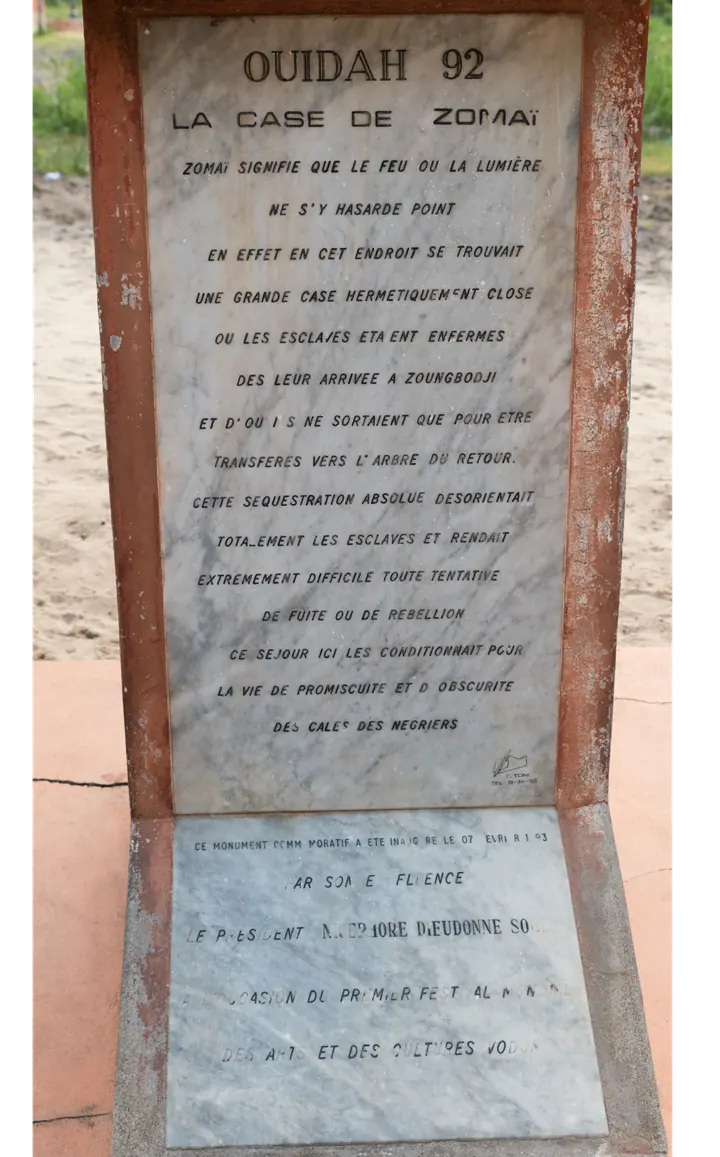
Further down, a stone marks where the Zomaï hut stood. Captives were held there in complete darkness before embarkation, to break them in for the hold of the ship. The name is explained locally as meaning that light does not enter. There is nothing to see on that empty ground, and that is precisely what you come to see.
The Memorial of the Great Sacrifice
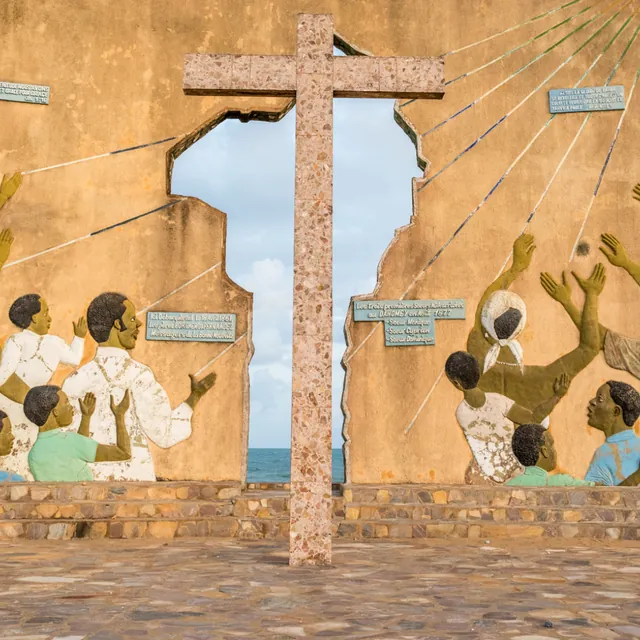
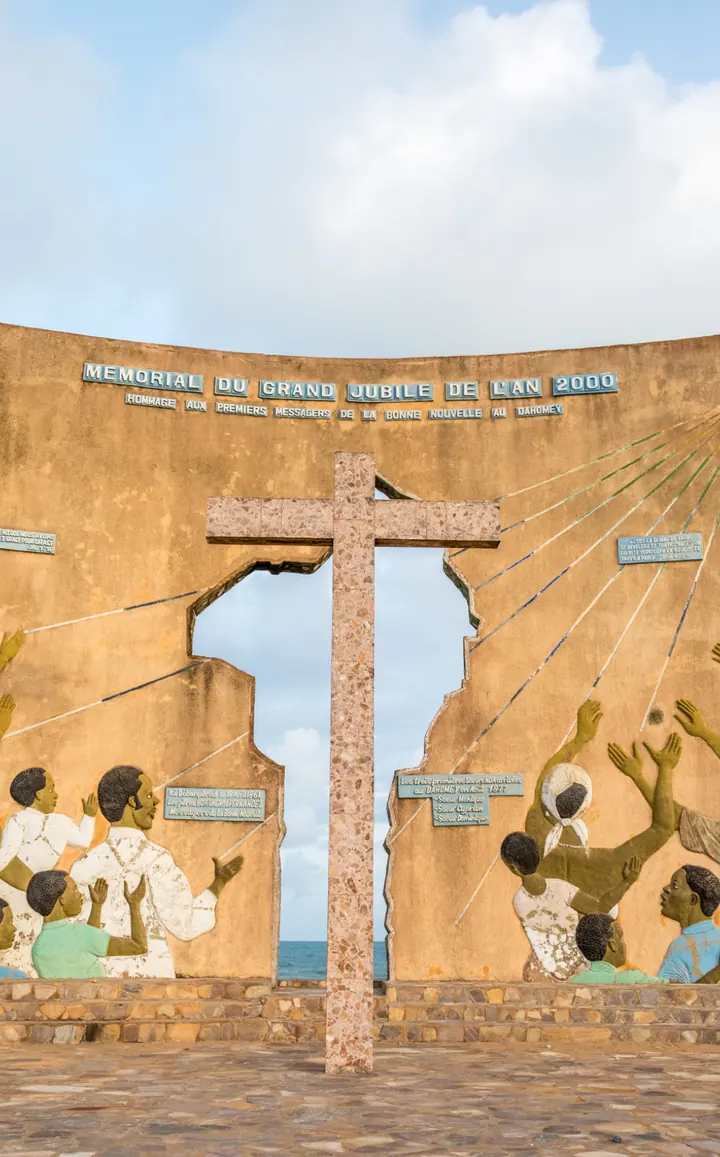
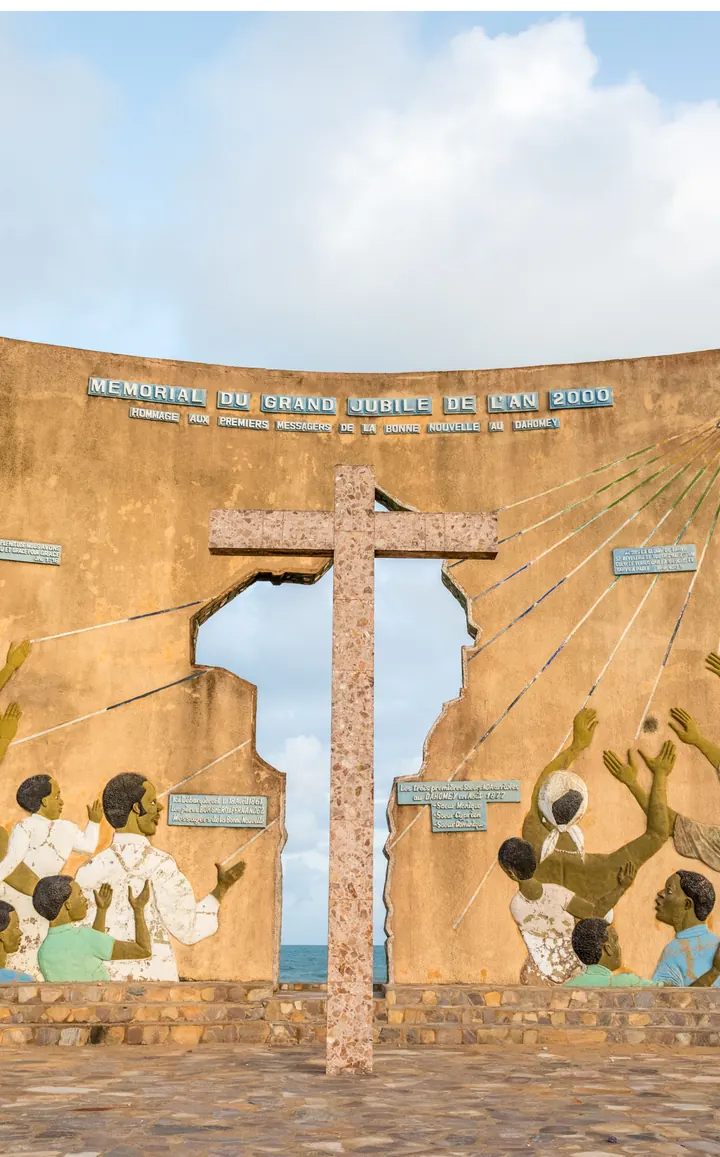
A stone cross at the centre of a large ochre mural, at the roadside. The memorial recalls those who died before they ever saw the sea. This is usually the point on the walk where groups stop talking, and where Tony, who has been telling the story since the square, falls silent too.
The Door of No Return
At the end, the sand becomes beach and the arch stands facing the water. Its reliefs show a line of chained captives walking towards the ocean, their backs to the land. Behind it there is nothing but the Gulf of Guinea and the sound of the surf. You stay longer than you meant to, and nobody asks to leave.
The sacred forest of Kpassè
Back towards town, and a complete change of register. The wood carries the name of Kpassè, the founding king of Ouidah, of whom it is said that he did not die but took the form of a tree. That is why the forest has never been felled.
Beneath the tall trunks stand statues of vodun deities in painted concrete, some of them taller than a man. The shade is thick, the air cooler than in town, and the noise of the motorbikes stops at the gate. You walk slowly and speak quietly. It is often the end of the day you need after the Slave Route.
The Vodun Days, in January
Every January, Benin celebrates its endogenous religions and Ouidah is the heart of it: processions, drums, open convents, part of the diaspora home for the occasion. The town changes scale. It is the most intense period of the year, and the least restful.
The exact dates are announced each year: check them before you book flights. Accommodation is the bottleneck, because the town fills up and past a certain point the rooms are simply gone. If your dates fall in January, we build the itinerary around the event rather than the other way round.
Getting to Ouidah from Cotonou
Ouidah is reached by the coastal road, heading west. The drive itself is short; what varies is getting out of Cotonou and its traffic. Leave early and you gain the whole morning — which matters, because the Slave Route walks better before the sand heats up.
- By private vehicle with a driver: the most flexible. You stop where you like, leave when you are done, and the vehicle follows the walk down to the beach.
- By shared taxi from Cotonou: the cheap option. You leave when the car is full, and you are dropped at the edge of the main road.
- By zémidjan once you are there: that is what you take to reach the memorials or come back up from the shore. Agree the fare before you get on.
One detail that saves a bad memory: there is no shade between the memorials. Bring water, a hat, and shoes that can take sand.
How long to allow
What to do in Ouidah depends above all on the pace you accept. We allow two to three days on our journeys, and that is not comfort: it is what it takes not to go from a place of memory to lunch within the same half hour.
- Half a day: the Python Temple and the sacred forest of Kpassè, without hurrying.
- A full day: add the Slave Route on foot down to the Door of No Return.
- Two to three days: you go back to the beach, linger in the old centre, and meet people.
- In January: add the Vodun Days on top of all of it, and book far ahead.
How to behave at places of memory and worship
Ouidah is not an open-air museum. The temple receives worshippers, the sacred forest is a place of worship, and the Slave Route runs through neighbourhoods where people live. You take off your shoes where you are asked to, you do not climb on the memorial stones, you do not touch the statues, and you lower your voice when a group is praying.
On clothing: shoulders and knees covered, shoes that come off easily. And one thing travellers are rarely told: the walk down to the Door of No Return shakes a lot of people. It is not a failure to sit down in the sand and say nothing for a quarter of an hour.
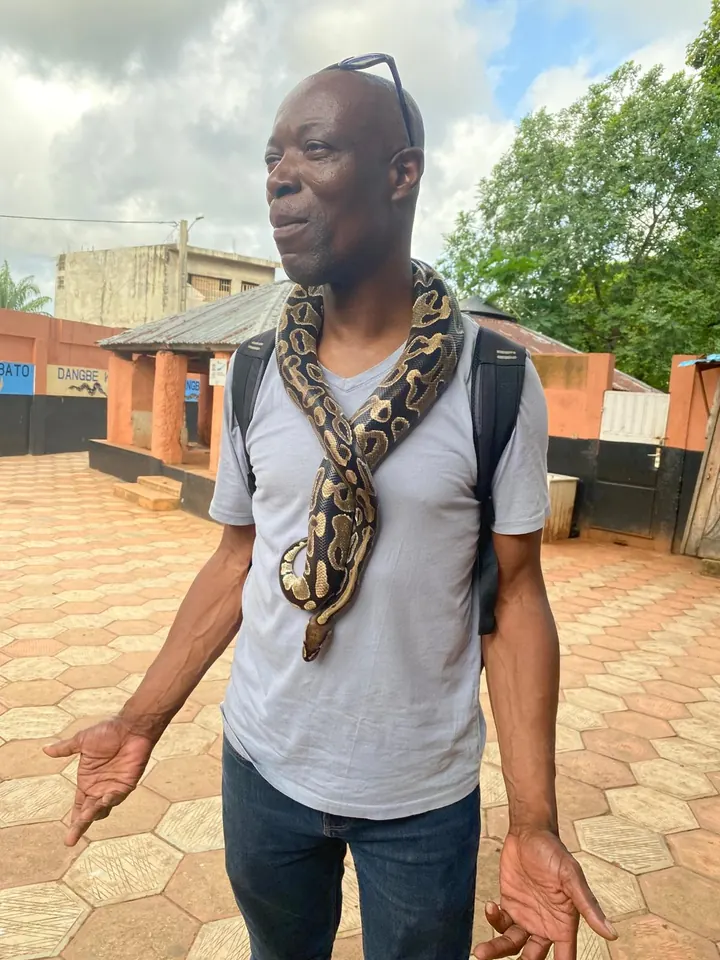
We do Ouidah with Tony, who knows the temple keepers and the families of the town. It does not change the list of places: it changes what you are told about them, and what you are allowed to see.
Frequently asked questions
Yes, as at most sites in Benin, and a photography fee can be added to the ticket. Amounts are posted on site and do change, so we do not publish them here rather than give you a wrong figure. On our journeys the entrance fees are settled, so you have nothing to pay.
Yes, and it is the most common way to do it. Leave early, take the temple first thing, the Slave Route before midday, the sacred forest late in the afternoon. You will see the essentials. You simply will not have time to stop in the old centre or go back down to the beach.
No. You are offered, you accept or decline, and nobody insists. The royal python is not venomous and the temple snakes are used to visitors, but if snakes make you uncomfortable, stay in the courtyard: the rest of the visit loses nothing.
Nothing stops you: the track is public and the memorials are open. But with nobody to tell the story, you walk past statues without knowing what they mark. Guides offer their services on site; we walk it with Tony, who grew up with these accounts.
The old centre is walkable: the former Portuguese fort, which houses the town’s history museum, the Afro-Brazilian houses, and the beach at the end of the Slave Route. Ask locally what is open on the day you visit — it varies.
Next step
Ready to actually go?
Tony builds the itinerary around whatever made you want to go. Just tell him what stayed with you from this article.
Answer within 24h · No commitment