best time to travel Benin Togo · 10 min
When is the best time to visit Benin and Togo?
November to March, and we stand by that. But the gap between December and March is real, and a well-planned rainy season gives you a different trip — not a lesser one.
The short answer, and what it hides
November to March. That is what we answer nine times out of ten, and it is right. The dry season keeps the roads usable, the heat bearable and the light clean from morning to evening. If nothing constrains your calendar, take that window and you can stop reading here.
The rest of this article is for those who do not have that luxury. Whose leave falls in July. Who want to see the country green rather than golden. Who are hesitating between December and March without knowing what it actually changes. Because the gap between two months of the same season is real, and because there is no genuinely bad time to come: there are different trips, and itineraries that have to be built differently.
November to March: the dry season
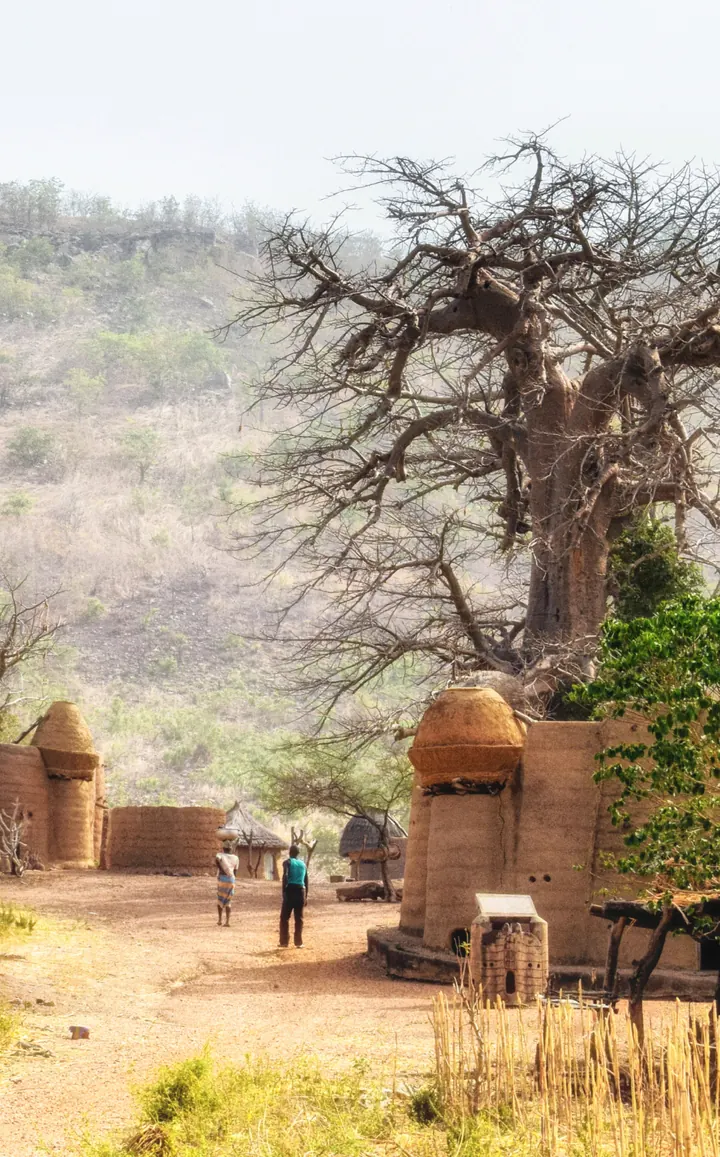
This is when Benin and Togo let you cross them without argument. Rain no longer turns up in the middle of the day, the red earth holds under the wheels, and tracks that become streams three months later are driven normally. For an itinerary heading north, that is not a comfort detail: it is what makes the stage possible at all.
What the road does to the plan
A dry track hands you time back. Journeys roughly keep to their timings, you reach the village before dark, and there is slack left to stop where nobody planned to stop. Our best hours of travel are exactly those: the unplanned market, the conversation that runs long on a bench, the detour decided at noon. In the dry season the day has room for it.
The light, and the hour you go out
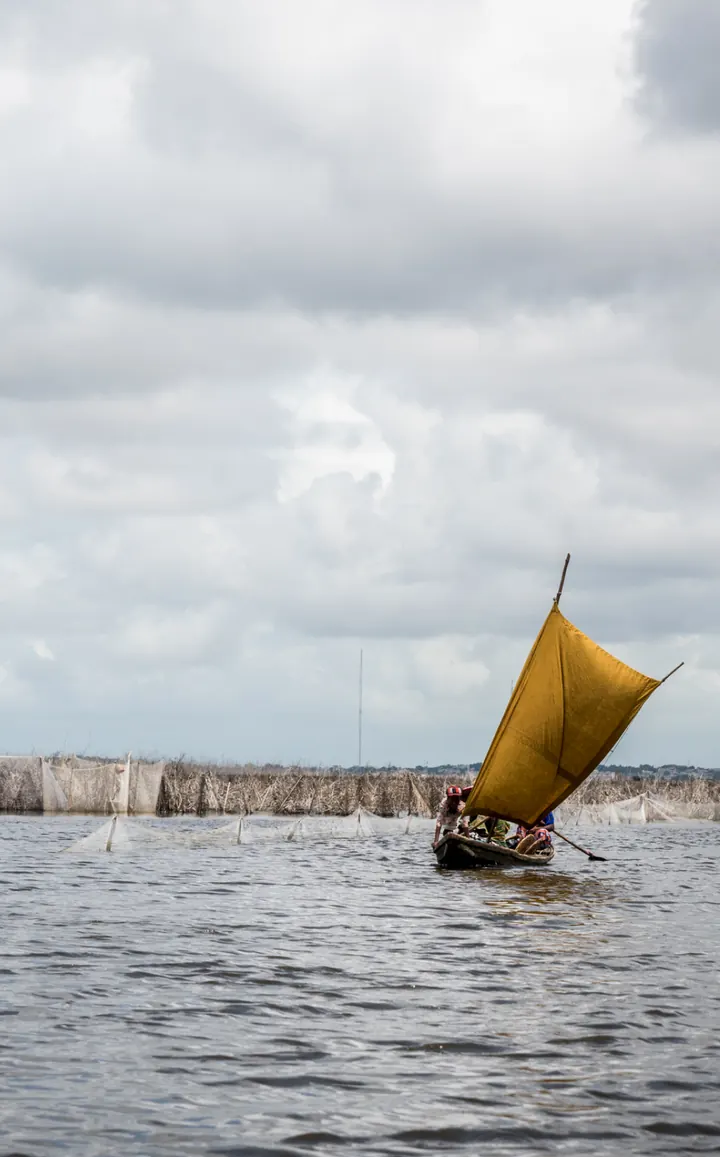
It is clean, hard in the middle of the day, superb at both ends. You leave early, and that is not for show: you board the Ganvié pirogue at daybreak because the lake is still milky, the air is cool and the wind has not risen. In the evening, from a tata terrace, the valley stretches out in shadow to the hills. In between you sit in the shade like everyone else, and you do not fight it.
January, and the Vodun Days
January stands apart. It is the month of the Vodun Days in Ouidah, and the town changes scale for a few days. The dates are announced each year: we do not fix them here and we pass them on as soon as they are known. What is worth knowing now is that the bottleneck in that window is neither the flight nor the visa, but the room. Ouidah is not a hotel town and its capacity does not move.
The harmattan, the veil nobody warned you about
At the heart of the dry season a dry wind comes down from the north-east carrying Saharan dust. That is the harmattan. It does not behave like ordinary weather: it settles in, holds for a few days, leaves, comes back. Some years it stays discreet; others it holds the horizon for weeks. Nobody can tell you in advance what it will do in a given year, and be wary of anyone who tries.
In practice it changes three things. The air turns very dry: your lips, throat and eyes feel it before you do, and you drink more than you expect. The sky loses its blue and goes milky white; the sun becomes a disc you can look straight at, and distant views flatten out. And the nights turn markedly cooler, especially in the north — enough that a thin fleece is not absurd in the hills around Kara.
Is that a reason to give up on it? No. It is a reason not to pick your dates on the promise of a blue sky. A harmattan haze also gives low, soft light in which market scenes, workshops and portraits look wonderful. It is the wide landscape that suffers; the rest of it rather gains.
April to July, then September–October: the heavy rains
The heavy rains run roughly from April to July, then return in September–October. "Roughly" is the honest word: those edges shift from year to year, and nobody on the ground will give you a date. You see them coming by the smell and the colour of the sky, not by the calendar.
What the rain gives you
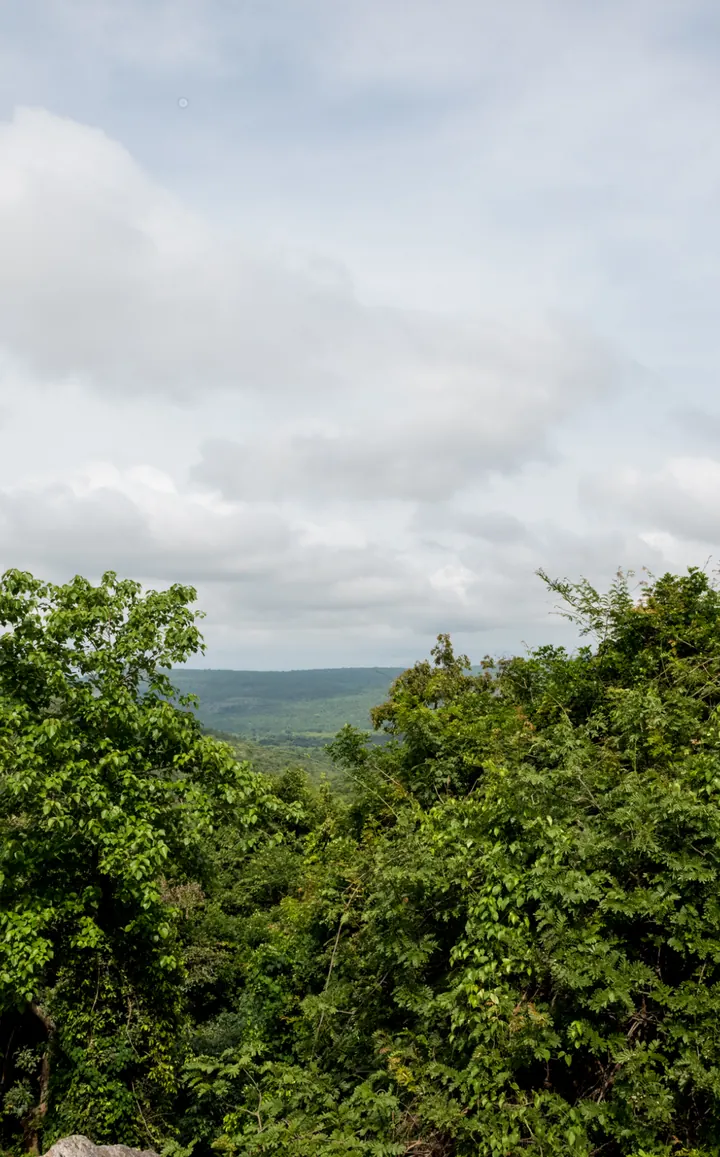
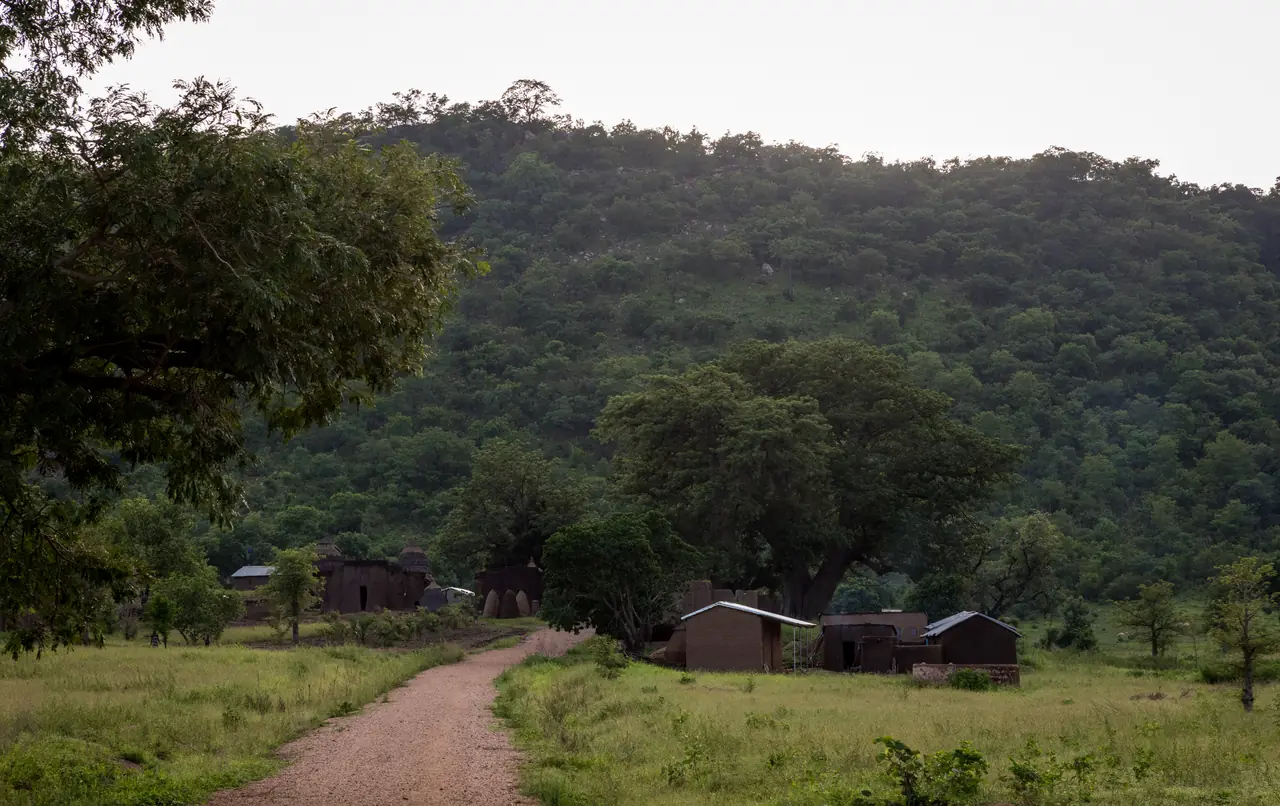
A green country, a green the dry season never shows you. The hills of northern Togo close in, the silk-cotton trees come back, and the red earth darkens all at once under a storm. It rains hard and rarely for long, often late in the afternoon: you do not lose whole days, you lose hours. Sites are empty, village life does not change an inch, and you can end up the only travellers on the stage.
What the rain costs you
The tracks. That is the real subject, and there is nothing cosmetic about it. After several days of downpours some northern tracks become difficult, and a leg announced at three hours can take five — or stop being possible at all. We do not drive long distances at night, which means a lost morning pushes the whole rest of the day back. That, and nothing else, is why we place Kara and Tamberma country between November and March.
The south takes it far better. Cotonou, the Route des Pêches, Ganvié, Abomey, Ouidah, Grand-Popo: tarmac roads and short distances. A trip tightened onto southern Benin works in the rainy season without acrobatics — a light waterproof, shoes that dry fast, and a calm acceptance that late afternoons are not yours to schedule.
Month by month, without promises
Here is how we read the year. These are tendencies, not guarantees: a dry year and a wet year look nothing alike, and we have seen both.
- November — the rains letting go. The landscape is still green, the roads come back, visitor numbers have not started. It is a month we are very fond of.
- December to February — the heart of the dry season. The best road conditions of the year, the coolest nights in the north, and the harmattan to expect without knowing when.
- January — the same conditions, plus the Vodun Days in Ouidah. To be arranged well ahead, for the accommodation above all.
- March — still dry, but the heat climbs clearly and the air thickens before the first rains. The day rearranges itself around the cool hours.
- April to July — the main rainy season. A superb country, short violent storms, and northern tracks to watch closely. The south stays entirely doable.
- August — often a relative lull on the coast, a grey, mild sky between two spells. It is not a second dry season, it is a breather.
- September–October — the second rainy season. The green is at its peak and the northern tracks at their worst.
North and south do not live the same year
It is rarely said, and yet it is the most useful point in this article: talking about one single "season" for the whole of Benin and Togo is a simplification. On the coast the rains fall in two spells separated by a lull. The further north you go, the more that tightens into a single wet season, shorter and more concentrated, with markedly cooler nights the rest of the year.
The consequence is practical. A trip that stays in the south has a much wider window than one climbing to Kara and Batammariba country. So if your dates are fixed and land in the middle of the rains, the right question is not "should we give up?" but "what goes on the itinerary?". The second one we are happy to answer.
Choosing by what you came for
- The Vodun Days and the fervour of Ouidah: January, and nothing replaces that moment.
- The north, the tatas of Tamberma country, the heights above Kara: November to March, without hesitation.
- Saturated green landscapes and empty sites: May–June or September–October, staying in the south.
- Wide landscape photography: November and early December, before the harmattan veils the horizon.
- A first trip with no particular constraint: December or February, the two easiest months to drive.
What we do with all this
Our fourteen-day itinerary stays in Benin: Cotonou, the Route des Pêches and Ganvié, Abomey, Ouidah, then Grand-Popo to come back down. It carries the year well, because the distances are short and the roads good. The stages that demand a real dry season — Kara, Tamberma country, a night or two in Agotohui — sit between November and March, and we tell you that before you book your time off, not after.
The way to go about it is simple: give us your dates, even approximate ones. Tony comes back to you with what that window genuinely allows, what it makes unlikely, and what to put in your bag. If your dates fall badly for what you wanted to see, we will say so plainly, even if it means suggesting you wait six months. It has happened before, and those turn out to be very good trips.
Frequently asked questions
Yes, provided you choose the itinerary accordingly. Southern Benin — Cotonou, the Route des Pêches, Ganvié, Abomey, Ouidah, Grand-Popo — stays reachable: tarmac roads and short distances. It is the northern tracks that turn difficult after several days of downpours. Tell us your dates and we will tell you what holds up and what is better left for another time.
It varies a great deal, and that is the only honest answer. It comes in spells of a few days during the dry season, breaks off, returns. Some years it goes almost unnoticed, others it holds the horizon for weeks. Pack lip balm and a water bottle, accept that the sky may stay white — and check local forecasts a few days ahead, not six months ahead.
Cold, no. Distinctly cooler than Cotonou, yes, especially in the dry season and up on the heights around Kara, where mist still sits in the hollows at daybreak. A thin fleece or a long-sleeved shirt covers the evenings and the early starts. The rest of the time you dress as you would in the south.
The rainy months, without question: sites are quiet and you are sometimes alone on a stage. If you want the compromise, aim for November: the roads are already good again, the landscape is still green and the season has not begun. At the other end, January brings both the Vodun Days and the busiest crowds of the year in Ouidah.
Yes, and particularly for January, when accommodation in Ouidah goes first. For the rest of the dry season the constraint is mainly group size: we travel in small numbers and the places in that window fill before the others. Write to us as soon as your dates firm up, even if you are not certain — it commits you to nothing.
Next step
Ready to actually go?
Tony builds the itinerary around whatever made you want to go. Just tell him what stayed with you from this article.
Answer within 24h · No commitment